Fonterra spent this year bringing New Zealand farmers to China - part of a years-long effort, alongside a government standard (90% grass in the diet, 340 days a year on pasture) and third-party certification, to give "grass-fed" the weight there that it already has at home.
Here is the tell. Say "grass-fed" to a shopper in Shanghai and a fair number will think: don't all cows eat grass? It sounds like a trick, or a statement of the obvious.
A claim needs a contrast the buyer already carries
In New Zealand, most shoppers can picture the alternative: grain, concentrate, an animal finished fast in a feedlot. Years of pastoral-farming identity and public argument about industrial agriculture built that picture, so "grass-fed" tends to read straight away as not that.
China didn't have that argument in the same terms. Remove the feedlot and "grass-fed" has nothing to push against. The translation - 草饲, literally "grass-fed" - is accurate, and the meaning still doesn't land.
The instinct behind the claim is entirely familiar - it just runs on a different set of ideas. Three of them matter, because a premium food claim in China lives or dies on whether it connects to one.
1. Food is medicine, and the tonic occasion is sacred
Chinese food culture holds that 药补不如食补 - tonic food beats tonic medicine - and 药膳, medicinal cookery, is often called its most refined branch. Chicken sits near the centre of it: chicken soup is held to 补气补血, restore energy and blood, and an old hen stewed long is the standard remedy for anyone weak, pale or run down.
That belief comes with occasions. Elderly parents are built up with tonic food through winter, on the traditional logic that "a winter of nourishment lets you fight tigers come spring". Convalescents get the same. A new mother in 坐月子, the month of postpartum confinement, is fed chicken soup daily - families still argue over whether a rooster or a hen makes the better one.
These are the moments when a household spends without flinching, and when an elder, not the shopper in the aisle, often decides what goes in the pot. A product that credibly belongs in that context has left price sensitivity behind.
2. Industrial food is not trusted, and the suspicion is specific
The 2008 melamine milk scandal is not history to Chinese parents; it reset the category. "Made in a factory, fast" now reads as a risk to be managed.
Take the 白羽鸡, the white-feather broiler that reaches weight in six weeks. A durable rumour says it is pumped with hormones. It isn't - the speed is breeding and husbandry, and hormones are barely feasible at that scale - but the belief holds, partly because feed formulas are trade secrets and people fill the silence with suspicion. Against that, a bird that took a year is not just tastier. It is legible: you can picture how it lived.
3. "土" (Tu) is a premium, and nostalgia sets the price
"土" - rustic, native, of the soil - and its cousins 农家 and 散养 are among the strongest value signals in Chinese food. Shoppers will pay well above the standard price for them, sometimes several times over. Some rent a patch of farmland and grow their own vegetables at a cost far above just buying them, for the reassurance of having watched it happen.
Be honest about the gap that opens. China's national food-quality testing centre compared free-range eggs with commercial ones and found no significant difference across more than forty nutrients - a result the Chinese Nutrition Society and state science-outreach outlets have repeated for years. The premium buys flavour, texture and a memory of how food used to be. The pull is strong enough to invite abuse: in 2026 China's trademark regulator invalidated more than a thousand "scheming" marks, among them a run of "native pig" and "native chicken" brands that had been engineered to imply free-range where there was none.
走地鸡 carries all three at once
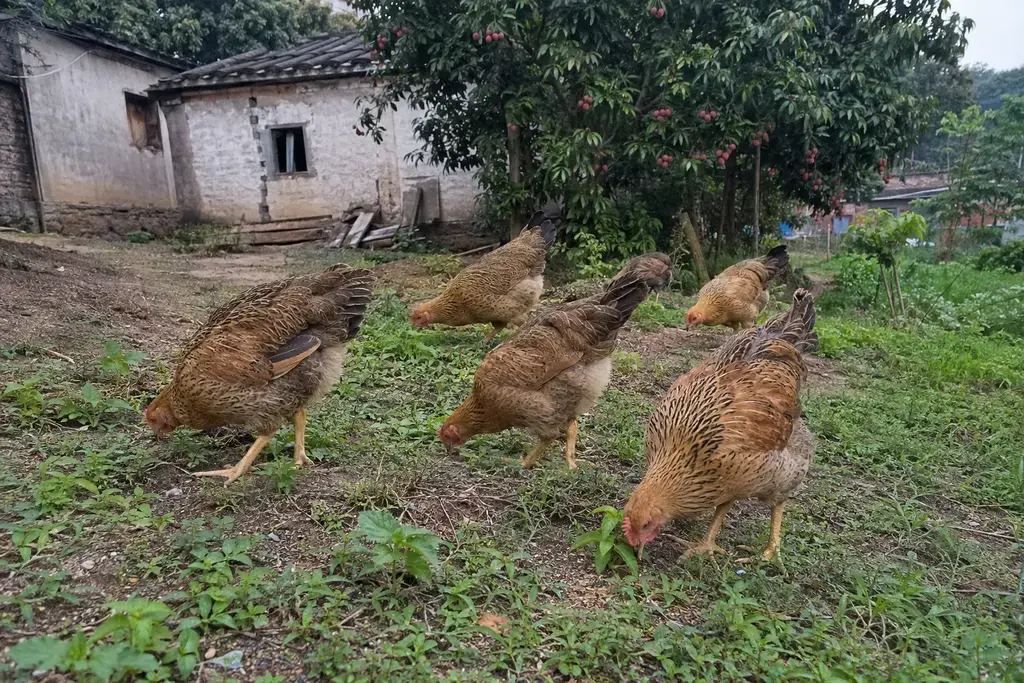
走地鸡 - "walk-the-ground chicken" - is a Cantonese term bound up with 白切鸡, chicken poached in plain water and served unseasoned, a Qing-dynasty tavern dish whose method is now listed as provincial heritage in Qingyuan. The dish adds nothing, so a poor bird has nowhere to hide. The word arrives carrying a cuisine's worth of judgement about what a good chicken is.
It is also the tonic bird, the anti-industrial bird and the 土 bird, in one everyday phrase no marketer had to build. A shopper reading 草饲 has to be taught what to feel. A shopper reading 走地鸡 feels it before they finish the word.
There is no 走地牛, of course. The asset isn't the word - it's the beliefs the word proves Chinese shoppers already hold. A beef or dairy claim borrows the beliefs, not the term.
Why grass-fed is landing anyway
草饲 is gaining ground - not on welfare or emissions, which is how it is usually framed at home, but by slotting into the post-scandal logic: internationally certified, independently checked, therefore safe. The standard and the certification mark are the message. The pasture is almost incidental.
How to make the jump
Here is the tell. Say "grass-fed" to a shopper in Shanghai and a fair number will think: don't all cows eat grass? It sounds like a trick, or a statement of the obvious.
A claim needs a contrast the buyer already carries
In New Zealand, most shoppers can picture the alternative: grain, concentrate, an animal finished fast in a feedlot. Years of pastoral-farming identity and public argument about industrial agriculture built that picture, so "grass-fed" tends to read straight away as not that.
China didn't have that argument in the same terms. Remove the feedlot and "grass-fed" has nothing to push against. The translation - 草饲, literally "grass-fed" - is accurate, and the meaning still doesn't land.
The instinct behind the claim is entirely familiar - it just runs on a different set of ideas. Three of them matter, because a premium food claim in China lives or dies on whether it connects to one.
1. Food is medicine, and the tonic occasion is sacred
Chinese food culture holds that 药补不如食补 - tonic food beats tonic medicine - and 药膳, medicinal cookery, is often called its most refined branch. Chicken sits near the centre of it: chicken soup is held to 补气补血, restore energy and blood, and an old hen stewed long is the standard remedy for anyone weak, pale or run down.
That belief comes with occasions. Elderly parents are built up with tonic food through winter, on the traditional logic that "a winter of nourishment lets you fight tigers come spring". Convalescents get the same. A new mother in 坐月子, the month of postpartum confinement, is fed chicken soup daily - families still argue over whether a rooster or a hen makes the better one.
These are the moments when a household spends without flinching, and when an elder, not the shopper in the aisle, often decides what goes in the pot. A product that credibly belongs in that context has left price sensitivity behind.
2. Industrial food is not trusted, and the suspicion is specific
The 2008 melamine milk scandal is not history to Chinese parents; it reset the category. "Made in a factory, fast" now reads as a risk to be managed.
Take the 白羽鸡, the white-feather broiler that reaches weight in six weeks. A durable rumour says it is pumped with hormones. It isn't - the speed is breeding and husbandry, and hormones are barely feasible at that scale - but the belief holds, partly because feed formulas are trade secrets and people fill the silence with suspicion. Against that, a bird that took a year is not just tastier. It is legible: you can picture how it lived.
3. "土" (Tu) is a premium, and nostalgia sets the price
"土" - rustic, native, of the soil - and its cousins 农家 and 散养 are among the strongest value signals in Chinese food. Shoppers will pay well above the standard price for them, sometimes several times over. Some rent a patch of farmland and grow their own vegetables at a cost far above just buying them, for the reassurance of having watched it happen.
Be honest about the gap that opens. China's national food-quality testing centre compared free-range eggs with commercial ones and found no significant difference across more than forty nutrients - a result the Chinese Nutrition Society and state science-outreach outlets have repeated for years. The premium buys flavour, texture and a memory of how food used to be. The pull is strong enough to invite abuse: in 2026 China's trademark regulator invalidated more than a thousand "scheming" marks, among them a run of "native pig" and "native chicken" brands that had been engineered to imply free-range where there was none.
走地鸡 carries all three at once
走地鸡 - "walk-the-ground chicken" - is a Cantonese term bound up with 白切鸡, chicken poached in plain water and served unseasoned, a Qing-dynasty tavern dish whose method is now listed as provincial heritage in Qingyuan. The dish adds nothing, so a poor bird has nowhere to hide. The word arrives carrying a cuisine's worth of judgement about what a good chicken is.
It is also the tonic bird, the anti-industrial bird and the 土 bird, in one everyday phrase no marketer had to build. A shopper reading 草饲 has to be taught what to feel. A shopper reading 走地鸡 feels it before they finish the word.
There is no 走地牛, of course. The asset isn't the word - it's the beliefs the word proves Chinese shoppers already hold. A beef or dairy claim borrows the beliefs, not the term.
Why grass-fed is landing anyway
草饲 is gaining ground - not on welfare or emissions, which is how it is usually framed at home, but by slotting into the post-scandal logic: internationally certified, independently checked, therefore safe. The standard and the certification mark are the message. The pasture is almost incidental.
How to make the jump
- Name what your claim rules out at home. Grass-fed rules out the feedlot.
- Find the belief it maps to locally. In China: food raised slowly and naturally, the way it should be - and, underneath that, safe.
- Say it in language the market already owns. Tie the claim to an idea like 走地鸡 where one exists; borrow the association where it doesn't. Don't coin a phrase no one has feelings about yet.
Then test it cold on someone in the market. If they say "isn't that just normal?", you've mistranslated.
Building new meaning works - Fonterra is proof - but it takes a standard, a budget, and years. Borrowing meaning that is already there is just translation done with cultural literacy, and it starts working immediately.