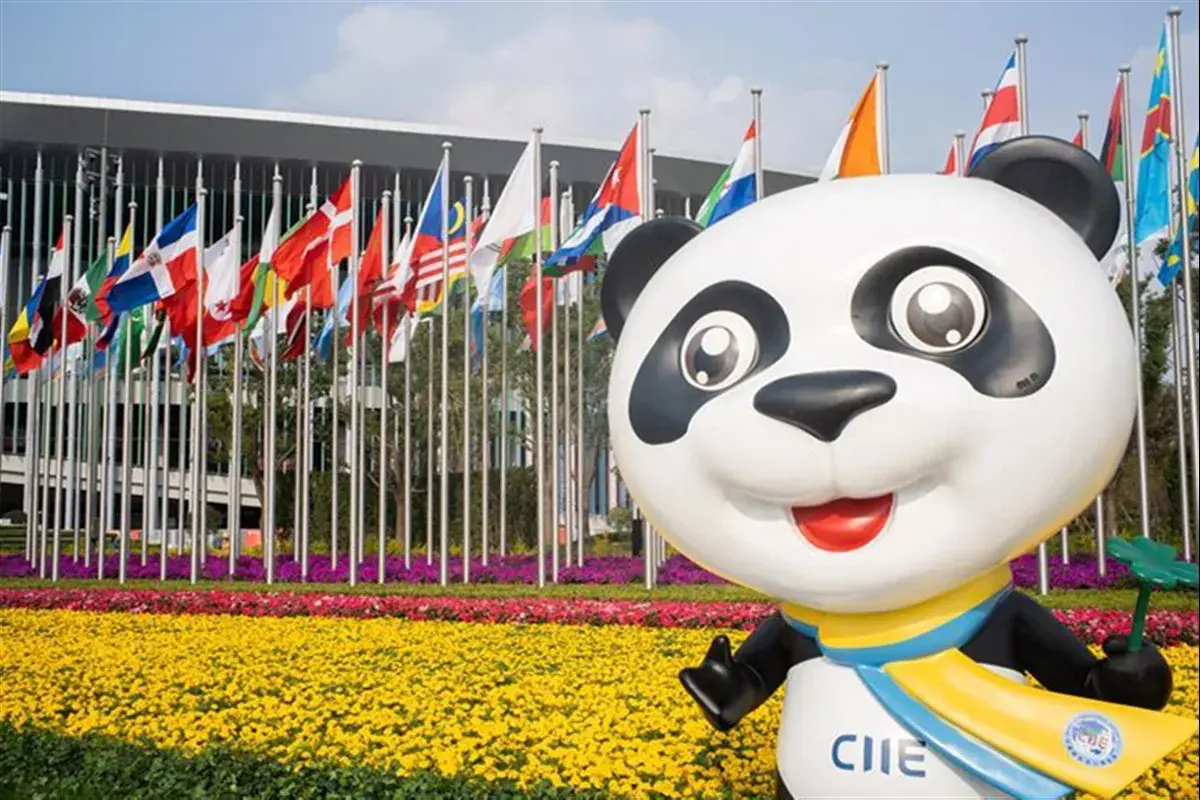
The decision to attend the China International Import Expo, or CIIE, is usually made for sensible reasons. For New Zealand and Australian businesses, China is not a speculative market. It is already one of the most significant trading relationships for both countries - New Zealand with two-way trade exceeding NZ$41 billion in the year ending September 2025, and Australia with its own substantial commercial ties to China underpinned by ChAFTA.
For Kiwi businesses, the decision to attend the China International Import Expo, or CIIE, is usually made for sensible reasons. China remains New Zealand’s largest trading partner, with two-way trade valued at more than NZ$41 billion in the year ending September 2025, and New Zealand exports to China totalled NZ$22.82 billion in the year ending September 2024. In other words, this is not a speculative market for New Zealand exporters. It is already central to the country’s trade structure.
CIIE sits inside that relationship as a very visible platform. Official CIIE materials describe it not as a normal trade fair, but as a national-level import platform. By the end of the 2025 edition, cumulative registered visitors had exceeded 3.3 million person-times, the 8th edition drew more than 460,000 registered visitors, and intended annual transaction value reached US$83.49 billion. Those figures help explain why exporters, trade agencies, and large buyers continue to take it seriously.
But this is also why first-time participation is easy to misread. The scale of the event can create the impression that opportunity is naturally built into attendance. In practice, first-time exhibitors often discover that CIIE is less forgiving than it looks from the outside. It rewards preparation that is commercially joined up. It exposes preparation that is partial, reactive, or built around the wrong assumptions.
What first-time exhibitors often miss is not the obvious work. They usually know they need a booth, products, brochures, and flights. What they miss is how CIIE actually functions as a business environment, and how much of the outcome is shaped before the exhibition floor becomes visible.
The first misunderstanding is treating CIIE as a visibility event rather than a decision environment
Many first-time exhibitors prepare as though the event’s main job is to make them visible. That is understandable. CIIE is large, high profile, and politically prominent. A strong visual presence feels important.
It is important, but not in the way many people assume.
At CIIE, visibility is only useful if it helps the right people understand quickly why the business matters to them. That sounds obvious, but it changes how preparation should be done. A booth is not successful because it looks polished. It is successful because it helps a buyer decide within a short interaction whether the product deserves more time.
This is where first-time exhibitors can drift into the wrong kind of preparation. They spend heavily on appearance, while leaving the commercial story too broad. They talk about brand values, company history, country reputation, and production capability, but they do not make the buyer’s practical decision easier. The buyer is not mainly asking whether the company is credible in a general sense. The buyer is asking whether this product can work in their channel, at their price level, with their customer base, and with a supplier who can support the relationship properly.
That difference matters. It is the difference between being noticed and being progressed.
The second misunderstanding is assuming serious buyer access happens naturally on the floor
From a distance, large exhibitions can appear to function through foot traffic. First-time exhibitors often imagine that good buyers will walk past, stop, and begin useful conversations if the stand is attractive enough.
Some of that does happen. But it is a weak strategy to rely on.
The more commercially valuable conversations at CIIE are often shaped before the event begins. Larger buyers, institutional buyers, and organised channel players do not usually arrive with empty diaries hoping to be surprised. They often come with agendas, schedules, categories of interest, and pre-arranged meetings. CIIE itself also promotes year-round matchmaking rather than treating the event as a one-week encounter. Across its first seven editions, the trade and investment matchmaking mechanism served more than 30,000 enterprises, completed more than 10,000 rounds of online and offline matchmaking, and generated around 5,300 cooperation intentions worth over US$50 billion. That tells you something important about how the platform is meant to work. Serious engagement is not based only on who wanders by.
This is one of the biggest gaps in first-time preparation. The company is often ready to exhibit, but not ready to arrive with a targeted meeting logic. As a result, it mistakes activity for traction. The stand is busy enough, plenty of people stop to talk, business cards are exchanged, but the ratio of relevant conversations to total conversations remains weak.
For a New Zealand exhibitor, this matters because travel distance and management attention are both expensive. If the quality of interaction depends too heavily on luck, the return profile deteriorates quickly.
The third misunderstanding is believing that country reputation can do more work than it really can
New Zealand enters China with real advantages. Its reputation in categories such as dairy, fruit, meat, health products, and certain premium food segments remains strong. The New Zealand-China trade relationship is established, and the Free Trade Agreement gives a favourable structural backdrop. MFAT notes that China is New Zealand’s largest trading partner, and the 2022 FTA upgrade added further trade facilitation and market access improvements.
But first-time exhibitors sometimes overestimate what this reputation can do on its own.
Country-of-origin credibility is useful because it reduces some initial doubt. It helps open the conversation. It can support trust. What it does not do is resolve the buyer’s commercial questions. A Chinese buyer still wants to know where the product fits, how it is priced, what its margin logic looks like, whether the packaging and claims work locally, whether volume and continuity are dependable, and whether the supplier will move fast enough after the event.
In other words, the New Zealand story helps open the door, but it does not carry the meeting. If the company arrives thinking that national reputation plus product quality will be enough, it may be surprised by how quickly conversations turn to operational and channel realities.
The fourth misunderstanding is underestimating how category-specific the China opportunity really is
First-time exhibitors often talk about China in broad terms. It is a large market. There is demand for quality. Buyers are looking for international products. All of that may be true, but it is not yet commercially precise.
China is not one market in any useful business sense. It is a set of regions, channels, price bands, consumer segments, and competitive dynamics that differ materially by category. A product that seems promising in theory may still be difficult to place in practice if the route to market is vague.
This matters even for sectors where New Zealand is strong. MFAT’s reporting on China shows that the market remains important across dairy, logs, fruit and other export categories, but conditions within those categories are not static. For example, MFAT’s 2024 China market reporting noted that in the first four months of 2024 New Zealand dairy exports to China reached NZ$2.4 billion, up 3 percent year on year, helped in part by the ending of the remaining milk powder tariffs under the FTA. That sounds positive, but it does not mean every dairy-related product or every channel route is equally attractive.
The problem for first-time exhibitors is not lack of enthusiasm. It is that enthusiasm can remain too general. Without a narrower view of which buyer type matters, which city tiers matter, which channels matter, and where the commercial fit really sits, the exhibition can become full of encouraging but low-consequence conversations.
The fifth misunderstanding is thinking the presentation job is mainly to inform
A first-time exhibitor often prepares materials as though the main objective is to give the buyer information. So the deck explains the company’s background, the product list, certifications, factory details, awards, and sometimes the founder’s story. None of this is wrong. The issue is that it is usually assembled from the company’s point of view, not from the buyer’s decision sequence.
At CIIE, buyers are rarely trying to become deeply educated on a company in the first interaction. They are trying to reduce uncertainty quickly. They want to know what the product is, where it fits, why it is relevant, whether it is commercially workable, and whether the supplier seems responsive and competent. If the material does not support that flow, it creates friction.
This is one reason some first-time exhibitors leave CIIE feeling that interest was high but follow-through was weak. The problem is not always that buyers were not serious. Sometimes the early interaction never became concrete enough to justify a next step. The information existed, but it was not structured in the order buyers needed.
The sixth misunderstanding is thinking logistics are separate from commercial readiness
In first-time planning, operational preparation and commercial preparation are often treated as different workstreams. One team deals with samples, shipping, product documents, and booth services. Another deals with messaging and meetings.
At CIIE, these things are not separate in the eyes of the buyer.
If a sample arrives late, if product information is unclear, if labelling is weak, if promised follow-up materials are not ready, or if the team cannot answer basic operational questions with confidence, the commercial conversation is weakened immediately. This is especially true for food, health, and consumer products, where buyers are often listening for signals of reliability as much as signals of attractiveness.
First-time exhibitors often underestimate how strongly execution details influence commercial perception. A buyer does not necessarily separate presentation quality from supplier quality. The way the company appears at the event becomes part of how the buyer judges what working together might feel like later.
The seventh misunderstanding is overvaluing the number of conversations
This is one of the most common first-time traps.
After the event, the company reports that the stand was busy, many contacts were made, and interest seemed strong. On the surface, this sounds encouraging. But volume is a poor substitute for progression.
At a large event like CIIE, it is relatively easy to generate polite interest. It is much harder to distinguish between curiosity, comparison-shopping, soft exploratory contact, and genuine channel intent. First-time exhibitors often lack a strong internal framework for sorting these signals while the event is still happening. Everything feels potentially valuable. The result is that post-event follow-up becomes too broad, too slow, and too generic.
That is where momentum usually fades. Not because nobody was interested, but because early filtering was weak. The business comes home with too many undifferentiated contacts and too little clarity on which conversations are commercially alive.
This is another area where more experienced exhibitors tend to behave differently. They are often less impressed by footfall and more disciplined about identifying which meetings deserve immediate commercial effort.
The eighth misunderstanding is underestimating the pace of post-event response required
For New Zealand businesses, one of the most practical issues is the simple fact of distance. Teams are smaller. Decision-makers may not all travel. Time zones create friction. Internal approvals can take time. None of this is unusual.
But at CIIE, these ordinary constraints can become commercially significant.
Chinese buyers often move quickly after large trade events. They compare multiple suppliers in parallel, expect useful follow-up quickly, and may lose focus if the supplier’s response becomes slow or vague. First-time exhibitors often prepare heavily for the event itself and lightly for the days immediately after it. That is a costly mismatch, because the period right after the exhibition is when a large share of early momentum is either converted or lost.
This is especially relevant given the scale of New Zealand’s participation. NZTE reported 58 New Zealand businesses exhibiting in 2024, the highest number since CIIE began, and more than 80 New Zealand businesses taking part in 2025, including a 1,000 square metre Taste New Zealand Pavilion housing 38 exhibitors. It also reported more than 20 commercial signings and projected trade value of up to NZ$450 million over the following 12 months. That does not mean every exhibitor achieved strong outcomes, but it does suggest a point worth noticing: the businesses getting value were not treating CIIE as a one-week display exercise. They were using it to move transactions, launches, and partner conversations forward.
What first-time exhibitors most need to understand
The deepest point is that CIIE should not be prepared for as an exhibition alone. It should be prepared for as a compressed commercial process.
That process starts before the event, when the business clarifies what it wants, who it wants to meet, and how it will be understood. It continues on-site, where the job is not to collect attention but to create the right next steps. And it matters just as much after the event, when speed, prioritisation, and continuity determine whether the exhibition produced real commercial movement or only temporary activity.
First-time exhibitors often prepare hardest for the most visible layer. They work on what will be seen. The stronger exhibitors also prepare for what will be decided.
Takeaway
For New Zealand businesses, CIIE can be a serious opportunity, but it is not an easy one. Its scale, government support, and buyer concentration make it valuable. Those same features also make it demanding.
What first-time exhibitors often miss is not one task, but one underlying truth: CIIE does not reward presence by itself. It rewards clarity, targeting, commercial readiness, and disciplined follow-through. The companies that understand this usually get more than visibility from the event. They give themselves a better chance of turning a busy week into something that still matters months later.
The ninth misunderstanding: underestimating the role of digital presence in buyer evaluation
A pattern that has become more pronounced in recent years is Chinese buyers using digital platforms to evaluate a supplier's credibility and brand strength before, during, and after CIIE. A buyer who receives a product card from an NZ or AU exhibitor may search for the brand on Xiaohongshu, Tmall, or Douyin within the same day. What they find - or fail to find - influences how seriously they treat the exhibition contact.
First-time exhibitors often invest heavily in the physical exhibition presence and less in the digital footprint that buyers are likely to check. A brand with a well-designed booth, professional materials, and a credible product that has no Chinese digital presence can create a credibility gap that more digitally established competitors benefit from. A buyer comparing two similar imported products - one with active Xiaohongshu presence and consumer reviews, one with no discoverable Chinese-language content - will typically be more confident progressing the former.
This does not mean first-time exhibitors need a fully developed Chinese digital marketing operation before CIIE. It does mean that a basic digital presence - an official Chinese-language Xiaohongshu account with professional product images and accurate information, or a brand profile on a relevant Chinese platform - is worth establishing before the event. The investment is modest relative to the total cost of CIIE participation, and the commercial return in terms of buyer confidence can be meaningful.
For Kiwi businesses, the decision to attend the China International Import Expo, or CIIE, is usually made for sensible reasons. China remains New Zealand’s largest trading partner, with two-way trade valued at more than NZ$41 billion in the year ending September 2025, and New Zealand exports to China totalled NZ$22.82 billion in the year ending September 2024. In other words, this is not a speculative market for New Zealand exporters. It is already central to the country’s trade structure.
CIIE sits inside that relationship as a very visible platform. Official CIIE materials describe it not as a normal trade fair, but as a national-level import platform. By the end of the 2025 edition, cumulative registered visitors had exceeded 3.3 million person-times, the 8th edition drew more than 460,000 registered visitors, and intended annual transaction value reached US$83.49 billion. Those figures help explain why exporters, trade agencies, and large buyers continue to take it seriously.
But this is also why first-time participation is easy to misread. The scale of the event can create the impression that opportunity is naturally built into attendance. In practice, first-time exhibitors often discover that CIIE is less forgiving than it looks from the outside. It rewards preparation that is commercially joined up. It exposes preparation that is partial, reactive, or built around the wrong assumptions.
What first-time exhibitors often miss is not the obvious work. They usually know they need a booth, products, brochures, and flights. What they miss is how CIIE actually functions as a business environment, and how much of the outcome is shaped before the exhibition floor becomes visible.
The first misunderstanding is treating CIIE as a visibility event rather than a decision environment
Many first-time exhibitors prepare as though the event’s main job is to make them visible. That is understandable. CIIE is large, high profile, and politically prominent. A strong visual presence feels important.
It is important, but not in the way many people assume.
At CIIE, visibility is only useful if it helps the right people understand quickly why the business matters to them. That sounds obvious, but it changes how preparation should be done. A booth is not successful because it looks polished. It is successful because it helps a buyer decide within a short interaction whether the product deserves more time.
This is where first-time exhibitors can drift into the wrong kind of preparation. They spend heavily on appearance, while leaving the commercial story too broad. They talk about brand values, company history, country reputation, and production capability, but they do not make the buyer’s practical decision easier. The buyer is not mainly asking whether the company is credible in a general sense. The buyer is asking whether this product can work in their channel, at their price level, with their customer base, and with a supplier who can support the relationship properly.
That difference matters. It is the difference between being noticed and being progressed.
The second misunderstanding is assuming serious buyer access happens naturally on the floor
From a distance, large exhibitions can appear to function through foot traffic. First-time exhibitors often imagine that good buyers will walk past, stop, and begin useful conversations if the stand is attractive enough.
Some of that does happen. But it is a weak strategy to rely on.
The more commercially valuable conversations at CIIE are often shaped before the event begins. Larger buyers, institutional buyers, and organised channel players do not usually arrive with empty diaries hoping to be surprised. They often come with agendas, schedules, categories of interest, and pre-arranged meetings. CIIE itself also promotes year-round matchmaking rather than treating the event as a one-week encounter. Across its first seven editions, the trade and investment matchmaking mechanism served more than 30,000 enterprises, completed more than 10,000 rounds of online and offline matchmaking, and generated around 5,300 cooperation intentions worth over US$50 billion. That tells you something important about how the platform is meant to work. Serious engagement is not based only on who wanders by.
This is one of the biggest gaps in first-time preparation. The company is often ready to exhibit, but not ready to arrive with a targeted meeting logic. As a result, it mistakes activity for traction. The stand is busy enough, plenty of people stop to talk, business cards are exchanged, but the ratio of relevant conversations to total conversations remains weak.
For a New Zealand exhibitor, this matters because travel distance and management attention are both expensive. If the quality of interaction depends too heavily on luck, the return profile deteriorates quickly.
The third misunderstanding is believing that country reputation can do more work than it really can
New Zealand enters China with real advantages. Its reputation in categories such as dairy, fruit, meat, health products, and certain premium food segments remains strong. The New Zealand-China trade relationship is established, and the Free Trade Agreement gives a favourable structural backdrop. MFAT notes that China is New Zealand’s largest trading partner, and the 2022 FTA upgrade added further trade facilitation and market access improvements.
But first-time exhibitors sometimes overestimate what this reputation can do on its own.
Country-of-origin credibility is useful because it reduces some initial doubt. It helps open the conversation. It can support trust. What it does not do is resolve the buyer’s commercial questions. A Chinese buyer still wants to know where the product fits, how it is priced, what its margin logic looks like, whether the packaging and claims work locally, whether volume and continuity are dependable, and whether the supplier will move fast enough after the event.
In other words, the New Zealand story helps open the door, but it does not carry the meeting. If the company arrives thinking that national reputation plus product quality will be enough, it may be surprised by how quickly conversations turn to operational and channel realities.
The fourth misunderstanding is underestimating how category-specific the China opportunity really is
First-time exhibitors often talk about China in broad terms. It is a large market. There is demand for quality. Buyers are looking for international products. All of that may be true, but it is not yet commercially precise.
China is not one market in any useful business sense. It is a set of regions, channels, price bands, consumer segments, and competitive dynamics that differ materially by category. A product that seems promising in theory may still be difficult to place in practice if the route to market is vague.
This matters even for sectors where New Zealand is strong. MFAT’s reporting on China shows that the market remains important across dairy, logs, fruit and other export categories, but conditions within those categories are not static. For example, MFAT’s 2024 China market reporting noted that in the first four months of 2024 New Zealand dairy exports to China reached NZ$2.4 billion, up 3 percent year on year, helped in part by the ending of the remaining milk powder tariffs under the FTA. That sounds positive, but it does not mean every dairy-related product or every channel route is equally attractive.
The problem for first-time exhibitors is not lack of enthusiasm. It is that enthusiasm can remain too general. Without a narrower view of which buyer type matters, which city tiers matter, which channels matter, and where the commercial fit really sits, the exhibition can become full of encouraging but low-consequence conversations.
The fifth misunderstanding is thinking the presentation job is mainly to inform
A first-time exhibitor often prepares materials as though the main objective is to give the buyer information. So the deck explains the company’s background, the product list, certifications, factory details, awards, and sometimes the founder’s story. None of this is wrong. The issue is that it is usually assembled from the company’s point of view, not from the buyer’s decision sequence.
At CIIE, buyers are rarely trying to become deeply educated on a company in the first interaction. They are trying to reduce uncertainty quickly. They want to know what the product is, where it fits, why it is relevant, whether it is commercially workable, and whether the supplier seems responsive and competent. If the material does not support that flow, it creates friction.
This is one reason some first-time exhibitors leave CIIE feeling that interest was high but follow-through was weak. The problem is not always that buyers were not serious. Sometimes the early interaction never became concrete enough to justify a next step. The information existed, but it was not structured in the order buyers needed.
The sixth misunderstanding is thinking logistics are separate from commercial readiness
In first-time planning, operational preparation and commercial preparation are often treated as different workstreams. One team deals with samples, shipping, product documents, and booth services. Another deals with messaging and meetings.
At CIIE, these things are not separate in the eyes of the buyer.
If a sample arrives late, if product information is unclear, if labelling is weak, if promised follow-up materials are not ready, or if the team cannot answer basic operational questions with confidence, the commercial conversation is weakened immediately. This is especially true for food, health, and consumer products, where buyers are often listening for signals of reliability as much as signals of attractiveness.
First-time exhibitors often underestimate how strongly execution details influence commercial perception. A buyer does not necessarily separate presentation quality from supplier quality. The way the company appears at the event becomes part of how the buyer judges what working together might feel like later.
The seventh misunderstanding is overvaluing the number of conversations
This is one of the most common first-time traps.
After the event, the company reports that the stand was busy, many contacts were made, and interest seemed strong. On the surface, this sounds encouraging. But volume is a poor substitute for progression.
At a large event like CIIE, it is relatively easy to generate polite interest. It is much harder to distinguish between curiosity, comparison-shopping, soft exploratory contact, and genuine channel intent. First-time exhibitors often lack a strong internal framework for sorting these signals while the event is still happening. Everything feels potentially valuable. The result is that post-event follow-up becomes too broad, too slow, and too generic.
That is where momentum usually fades. Not because nobody was interested, but because early filtering was weak. The business comes home with too many undifferentiated contacts and too little clarity on which conversations are commercially alive.
This is another area where more experienced exhibitors tend to behave differently. They are often less impressed by footfall and more disciplined about identifying which meetings deserve immediate commercial effort.
The eighth misunderstanding is underestimating the pace of post-event response required
For New Zealand businesses, one of the most practical issues is the simple fact of distance. Teams are smaller. Decision-makers may not all travel. Time zones create friction. Internal approvals can take time. None of this is unusual.
But at CIIE, these ordinary constraints can become commercially significant.
Chinese buyers often move quickly after large trade events. They compare multiple suppliers in parallel, expect useful follow-up quickly, and may lose focus if the supplier’s response becomes slow or vague. First-time exhibitors often prepare heavily for the event itself and lightly for the days immediately after it. That is a costly mismatch, because the period right after the exhibition is when a large share of early momentum is either converted or lost.
This is especially relevant given the scale of New Zealand’s participation. NZTE reported 58 New Zealand businesses exhibiting in 2024, the highest number since CIIE began, and more than 80 New Zealand businesses taking part in 2025, including a 1,000 square metre Taste New Zealand Pavilion housing 38 exhibitors. It also reported more than 20 commercial signings and projected trade value of up to NZ$450 million over the following 12 months. That does not mean every exhibitor achieved strong outcomes, but it does suggest a point worth noticing: the businesses getting value were not treating CIIE as a one-week display exercise. They were using it to move transactions, launches, and partner conversations forward.
What first-time exhibitors most need to understand
The deepest point is that CIIE should not be prepared for as an exhibition alone. It should be prepared for as a compressed commercial process.
That process starts before the event, when the business clarifies what it wants, who it wants to meet, and how it will be understood. It continues on-site, where the job is not to collect attention but to create the right next steps. And it matters just as much after the event, when speed, prioritisation, and continuity determine whether the exhibition produced real commercial movement or only temporary activity.
First-time exhibitors often prepare hardest for the most visible layer. They work on what will be seen. The stronger exhibitors also prepare for what will be decided.
Takeaway
For New Zealand businesses, CIIE can be a serious opportunity, but it is not an easy one. Its scale, government support, and buyer concentration make it valuable. Those same features also make it demanding.
What first-time exhibitors often miss is not one task, but one underlying truth: CIIE does not reward presence by itself. It rewards clarity, targeting, commercial readiness, and disciplined follow-through. The companies that understand this usually get more than visibility from the event. They give themselves a better chance of turning a busy week into something that still matters months later.
The ninth misunderstanding: underestimating the role of digital presence in buyer evaluation
A pattern that has become more pronounced in recent years is Chinese buyers using digital platforms to evaluate a supplier's credibility and brand strength before, during, and after CIIE. A buyer who receives a product card from an NZ or AU exhibitor may search for the brand on Xiaohongshu, Tmall, or Douyin within the same day. What they find - or fail to find - influences how seriously they treat the exhibition contact.
First-time exhibitors often invest heavily in the physical exhibition presence and less in the digital footprint that buyers are likely to check. A brand with a well-designed booth, professional materials, and a credible product that has no Chinese digital presence can create a credibility gap that more digitally established competitors benefit from. A buyer comparing two similar imported products - one with active Xiaohongshu presence and consumer reviews, one with no discoverable Chinese-language content - will typically be more confident progressing the former.
This does not mean first-time exhibitors need a fully developed Chinese digital marketing operation before CIIE. It does mean that a basic digital presence - an official Chinese-language Xiaohongshu account with professional product images and accurate information, or a brand profile on a relevant Chinese platform - is worth establishing before the event. The investment is modest relative to the total cost of CIIE participation, and the commercial return in terms of buyer confidence can be meaningful.
