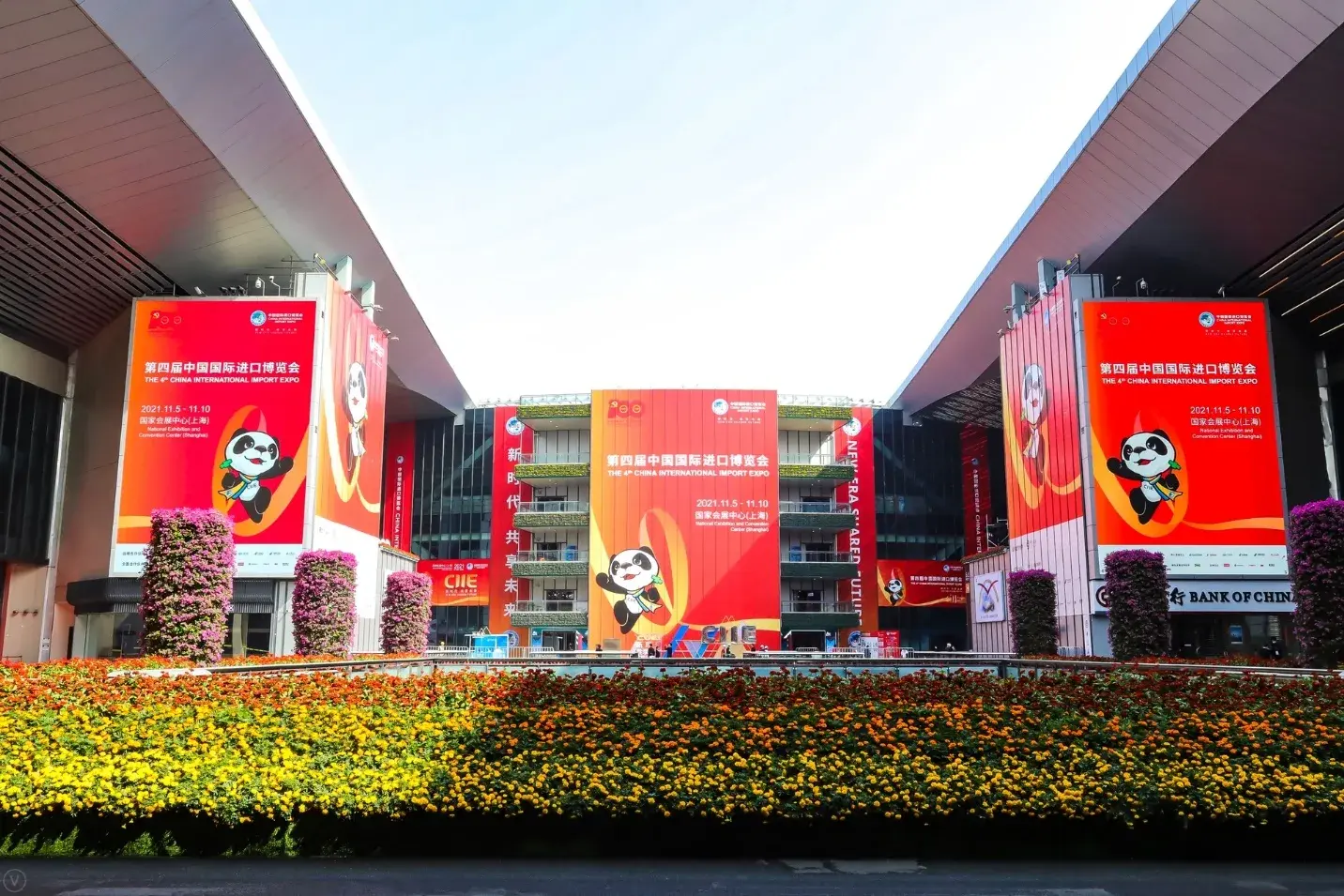
The China International Import Expo, or CIIE, is described in many ways: a national-level import platform, China's highest-profile exhibition for international suppliers, a government-backed trade initiative. Those descriptions are accurate. What they do not always convey is what the event actually involves in practical terms for New Zealand and Australian businesses deciding whether to participate.
This article explains what CIIE is, how it works, and what exhibitors from New Zealand and Australia typically experience across the three phases of participation: preparation, the event itself, and the follow-up period.
What CIIE is
CIIE is held annually in November at the National Exhibition and Convention Centre in Shanghai. It was launched in 2018 and is organised by the Chinese government, specifically through the Ministry of Commerce and the Shanghai Municipal People's Government, with the CIIE Bureau serving as the operational organiser.
The event is explicitly designed as an import platform - a place for overseas businesses to access Chinese buyers, not primarily for Chinese businesses to export. That distinction matters because it shapes the buyer composition: the organisations attending CIIE as buyers include state-linked procurement entities, large private importers, distributors, retailers, e-commerce platforms, and institutional buyers across multiple categories.
Official CIIE materials for the 8th edition in 2025 reported more than 4,100 exhibitors, 460,000 registered visitors, and intended annual transaction value reaching US$83.49 billion. Those figures convey the scale. What they do not convey is that CIIE's commercial value depends heavily on whether the right buyer and the right supplier are in the same conversation at the right moment.
How CIIE is structured
The exhibition is divided into product and service zones, broadly covering food and agricultural products, consumer goods, automotive, medical and healthcare equipment, services trade, and technology. New Zealand and Australian businesses most commonly exhibit in the food and agricultural products and consumer goods zones, consistent with the export profile of both countries.
Within those zones, exhibition space can be arranged independently or through country pavilions. New Zealand's participation has historically been coordinated through NZTE, which manages a country pavilion including a Taste New Zealand presence. Australian businesses can access similar coordination through Austrade. Country pavilions offer a structured way to participate and can provide additional visibility through country-level branding, but independent exhibiting is also possible for businesses that meet CIIE's application requirements.
The event typically runs for six days. The first two to three days are generally the most commercially active for buyer meetings and institutional engagement. Later days can be useful for consolidating conversations and conducting follow-up within the exhibition, but the peak buyer concentration is usually in the opening period.
What happens on the floor
On the exhibition floor, activity is concentrated but not uniform. The most commercially productive interactions at CIIE are generally pre-arranged meetings, not walk-up conversations. Buyers who attend with serious sourcing intentions typically come with schedules, category preferences, and in many cases a list of exhibitors they intend to visit.
Walk-up traffic does occur and can be useful, but businesses that rely primarily on floor traffic tend to have lower-quality commercial interactions than those who arrive with a pre-arranged meeting agenda. CIIE's matchmaking infrastructure supports pre-event meeting arrangements, and both NZTE and Austrade facilitate introductions for businesses in their respective programmes.
On the floor, the typical interaction sequence is a brief introduction, a high-level explanation of the product and its market fit, an exchange of materials, and a decision by the buyer about whether to explore further. Conversations rarely become commercially detailed during the exhibition itself. The exhibition is primarily a filtering environment: buyers are sorting which suppliers deserve more time. The detailed commercial discussion - pricing, logistics, channel economics, contract terms - almost always happens after the event.
What happens after CIIE
The post-exhibition phase is where the event either delivers commercial value or does not. For New Zealand and Australian businesses, this phase is often underestimated in both its importance and its demands.
In the days immediately following CIIE, buyer organisations are typically reviewing their notes, comparing suppliers, and deciding which conversations to prioritise. This is a competitive sorting process, and suppliers who follow up with clarity, speed, and commercial specificity are significantly more likely to advance than those who send generic post-event messages.
Post-event follow-up that reconnects quickly, addresses a specific commercial question, and makes the next step easy to understand is more effective than follow-up that simply acknowledges the meeting and expresses interest in future cooperation.
The commercial reality of CIIE
CIIE is a serious commercial platform, not primarily a visibility exercise. Official data about registered visitors and intended transactions are meaningful indicators of scale, but they are not directly related to any individual exhibitor's outcome. An exhibitor's return on participation is determined almost entirely by the quality of their preparation, the relevance of the buyers they engage, and the discipline of their post-exhibition follow-up.
New Zealand and Australian businesses that attend CIIE with a clear objective, prepared buyer-facing materials, targeted meeting intentions, and a structured post-event plan consistently get more from the event than those who attend primarily for exposure. That is not a limitation of the event. It is how any serious commercial platform works.
What does it cost to participate in CIIE?
For NZ and AU businesses evaluating CIIE, understanding the full cost before committing avoids the common problem of underbudgeting for an event that is considerably more expensive in total than the booth or registration fee suggests.
For independent exhibitors, booth space at CIIE is priced by square metre and varies by product zone. Booth space is only one component of the total cost. Additional costs typically include: booth design and build, which for a modestly sized custom booth at a major international trade event in China can represent a substantial investment; product freight and customs clearance for samples and display materials; interpreter fees for the event period; team travel and accommodation in Shanghai for six to eight days including setup; and pre-event compliance and materials preparation costs.
For businesses participating through NZTE's pavilion programme, shared infrastructure reduces some costs and the coordination overhead is lower. NZTE's support also includes access to market intelligence, buyer matchmaking, and pre-event preparation support that would otherwise need to be sourced independently. Austrade provides comparable support for Australian businesses. Both agencies can provide current cost structures and programme terms directly.
The ROI question for CIIE is ultimately a commercial one. The relevant calculation is not whether the event is expensive in absolute terms, but whether the total cost, set against the realistic commercial outcomes from adequate preparation, produces a return that justifies the investment relative to other market-building activities at the same stage.
Day by day: how the event is structured
CIIE typically runs for six days. Activity is not uniform across those days, and understanding how commercial intensity is distributed helps businesses structure their team's time more effectively.
Days one and two are the most commercially intensive. The most senior buyers, institutional procurement representatives, and category decision-makers are most active during the opening days. Pre-arranged meetings scheduled for these days tend to be with contacts at the highest engagement level. For businesses with a limited team or short event presence, prioritising day-one and day-two meeting quality over quantity is the commercially rational approach.
Days three and four see continued buyer activity with a broader mix of visitors including distributors, regional buyers, and platform procurement staff. These days are productive for building a pipeline of follow-up contacts and for more detailed product conversations with buyers refining their sourcing decisions.
Days five and six typically have lighter buyer traffic but can be valuable for consolidating earlier contacts, having extended conversations with interested buyers who were too busy in the first half, and attending category-specific sessions run by CIIE's organisers and industry bodies.
What makes a buyer conversation productive at CIIE
The character of a successful buyer conversation at CIIE differs from a typical sales meeting. Buyers at a major trade event are time-compressed and comparison-focused. They are sorting suppliers, not closing deals. A conversation that tries to close commercial terms at the event is usually less effective than one that establishes clarity, credibility, and a clear next step.
A productive buyer conversation at CIIE typically includes: rapid establishment of the product's commercial identity - what it is, who it is for, why it is positioned at its price; a clear answer to the commercial question the buyer is actually asking, which is often "where does this fit in my portfolio and can I build margins around it?"; and a defined next step the buyer finds easy to commit to - a specific follow-up call, a sample request, or a pricing discussion. Buyers who leave a CIIE conversation without knowing what the next step is rarely initiate it themselves.
The most common failure mode in CIIE conversations is providing too much information. A product with a complex provenance story, multiple range extensions, and detailed production credentials may be interesting to the exporter. A buyer at CIIE is making a rapid first assessment across many suppliers in a single day. The simpler and more commercially specific the initial conversation, the more likely it is to generate genuine follow-up.
This article explains what CIIE is, how it works, and what exhibitors from New Zealand and Australia typically experience across the three phases of participation: preparation, the event itself, and the follow-up period.
What CIIE is
CIIE is held annually in November at the National Exhibition and Convention Centre in Shanghai. It was launched in 2018 and is organised by the Chinese government, specifically through the Ministry of Commerce and the Shanghai Municipal People's Government, with the CIIE Bureau serving as the operational organiser.
The event is explicitly designed as an import platform - a place for overseas businesses to access Chinese buyers, not primarily for Chinese businesses to export. That distinction matters because it shapes the buyer composition: the organisations attending CIIE as buyers include state-linked procurement entities, large private importers, distributors, retailers, e-commerce platforms, and institutional buyers across multiple categories.
Official CIIE materials for the 8th edition in 2025 reported more than 4,100 exhibitors, 460,000 registered visitors, and intended annual transaction value reaching US$83.49 billion. Those figures convey the scale. What they do not convey is that CIIE's commercial value depends heavily on whether the right buyer and the right supplier are in the same conversation at the right moment.
How CIIE is structured
The exhibition is divided into product and service zones, broadly covering food and agricultural products, consumer goods, automotive, medical and healthcare equipment, services trade, and technology. New Zealand and Australian businesses most commonly exhibit in the food and agricultural products and consumer goods zones, consistent with the export profile of both countries.
Within those zones, exhibition space can be arranged independently or through country pavilions. New Zealand's participation has historically been coordinated through NZTE, which manages a country pavilion including a Taste New Zealand presence. Australian businesses can access similar coordination through Austrade. Country pavilions offer a structured way to participate and can provide additional visibility through country-level branding, but independent exhibiting is also possible for businesses that meet CIIE's application requirements.
The event typically runs for six days. The first two to three days are generally the most commercially active for buyer meetings and institutional engagement. Later days can be useful for consolidating conversations and conducting follow-up within the exhibition, but the peak buyer concentration is usually in the opening period.
What happens on the floor
On the exhibition floor, activity is concentrated but not uniform. The most commercially productive interactions at CIIE are generally pre-arranged meetings, not walk-up conversations. Buyers who attend with serious sourcing intentions typically come with schedules, category preferences, and in many cases a list of exhibitors they intend to visit.
Walk-up traffic does occur and can be useful, but businesses that rely primarily on floor traffic tend to have lower-quality commercial interactions than those who arrive with a pre-arranged meeting agenda. CIIE's matchmaking infrastructure supports pre-event meeting arrangements, and both NZTE and Austrade facilitate introductions for businesses in their respective programmes.
On the floor, the typical interaction sequence is a brief introduction, a high-level explanation of the product and its market fit, an exchange of materials, and a decision by the buyer about whether to explore further. Conversations rarely become commercially detailed during the exhibition itself. The exhibition is primarily a filtering environment: buyers are sorting which suppliers deserve more time. The detailed commercial discussion - pricing, logistics, channel economics, contract terms - almost always happens after the event.
What happens after CIIE
The post-exhibition phase is where the event either delivers commercial value or does not. For New Zealand and Australian businesses, this phase is often underestimated in both its importance and its demands.
In the days immediately following CIIE, buyer organisations are typically reviewing their notes, comparing suppliers, and deciding which conversations to prioritise. This is a competitive sorting process, and suppliers who follow up with clarity, speed, and commercial specificity are significantly more likely to advance than those who send generic post-event messages.
Post-event follow-up that reconnects quickly, addresses a specific commercial question, and makes the next step easy to understand is more effective than follow-up that simply acknowledges the meeting and expresses interest in future cooperation.
The commercial reality of CIIE
CIIE is a serious commercial platform, not primarily a visibility exercise. Official data about registered visitors and intended transactions are meaningful indicators of scale, but they are not directly related to any individual exhibitor's outcome. An exhibitor's return on participation is determined almost entirely by the quality of their preparation, the relevance of the buyers they engage, and the discipline of their post-exhibition follow-up.
New Zealand and Australian businesses that attend CIIE with a clear objective, prepared buyer-facing materials, targeted meeting intentions, and a structured post-event plan consistently get more from the event than those who attend primarily for exposure. That is not a limitation of the event. It is how any serious commercial platform works.
What does it cost to participate in CIIE?
For NZ and AU businesses evaluating CIIE, understanding the full cost before committing avoids the common problem of underbudgeting for an event that is considerably more expensive in total than the booth or registration fee suggests.
For independent exhibitors, booth space at CIIE is priced by square metre and varies by product zone. Booth space is only one component of the total cost. Additional costs typically include: booth design and build, which for a modestly sized custom booth at a major international trade event in China can represent a substantial investment; product freight and customs clearance for samples and display materials; interpreter fees for the event period; team travel and accommodation in Shanghai for six to eight days including setup; and pre-event compliance and materials preparation costs.
For businesses participating through NZTE's pavilion programme, shared infrastructure reduces some costs and the coordination overhead is lower. NZTE's support also includes access to market intelligence, buyer matchmaking, and pre-event preparation support that would otherwise need to be sourced independently. Austrade provides comparable support for Australian businesses. Both agencies can provide current cost structures and programme terms directly.
The ROI question for CIIE is ultimately a commercial one. The relevant calculation is not whether the event is expensive in absolute terms, but whether the total cost, set against the realistic commercial outcomes from adequate preparation, produces a return that justifies the investment relative to other market-building activities at the same stage.
Day by day: how the event is structured
CIIE typically runs for six days. Activity is not uniform across those days, and understanding how commercial intensity is distributed helps businesses structure their team's time more effectively.
Days one and two are the most commercially intensive. The most senior buyers, institutional procurement representatives, and category decision-makers are most active during the opening days. Pre-arranged meetings scheduled for these days tend to be with contacts at the highest engagement level. For businesses with a limited team or short event presence, prioritising day-one and day-two meeting quality over quantity is the commercially rational approach.
Days three and four see continued buyer activity with a broader mix of visitors including distributors, regional buyers, and platform procurement staff. These days are productive for building a pipeline of follow-up contacts and for more detailed product conversations with buyers refining their sourcing decisions.
Days five and six typically have lighter buyer traffic but can be valuable for consolidating earlier contacts, having extended conversations with interested buyers who were too busy in the first half, and attending category-specific sessions run by CIIE's organisers and industry bodies.
What makes a buyer conversation productive at CIIE
The character of a successful buyer conversation at CIIE differs from a typical sales meeting. Buyers at a major trade event are time-compressed and comparison-focused. They are sorting suppliers, not closing deals. A conversation that tries to close commercial terms at the event is usually less effective than one that establishes clarity, credibility, and a clear next step.
A productive buyer conversation at CIIE typically includes: rapid establishment of the product's commercial identity - what it is, who it is for, why it is positioned at its price; a clear answer to the commercial question the buyer is actually asking, which is often "where does this fit in my portfolio and can I build margins around it?"; and a defined next step the buyer finds easy to commit to - a specific follow-up call, a sample request, or a pricing discussion. Buyers who leave a CIIE conversation without knowing what the next step is rarely initiate it themselves.
The most common failure mode in CIIE conversations is providing too much information. A product with a complex provenance story, multiple range extensions, and detailed production credentials may be interesting to the exporter. A buyer at CIIE is making a rapid first assessment across many suppliers in a single day. The simpler and more commercially specific the initial conversation, the more likely it is to generate genuine follow-up.
